
 EN
EN



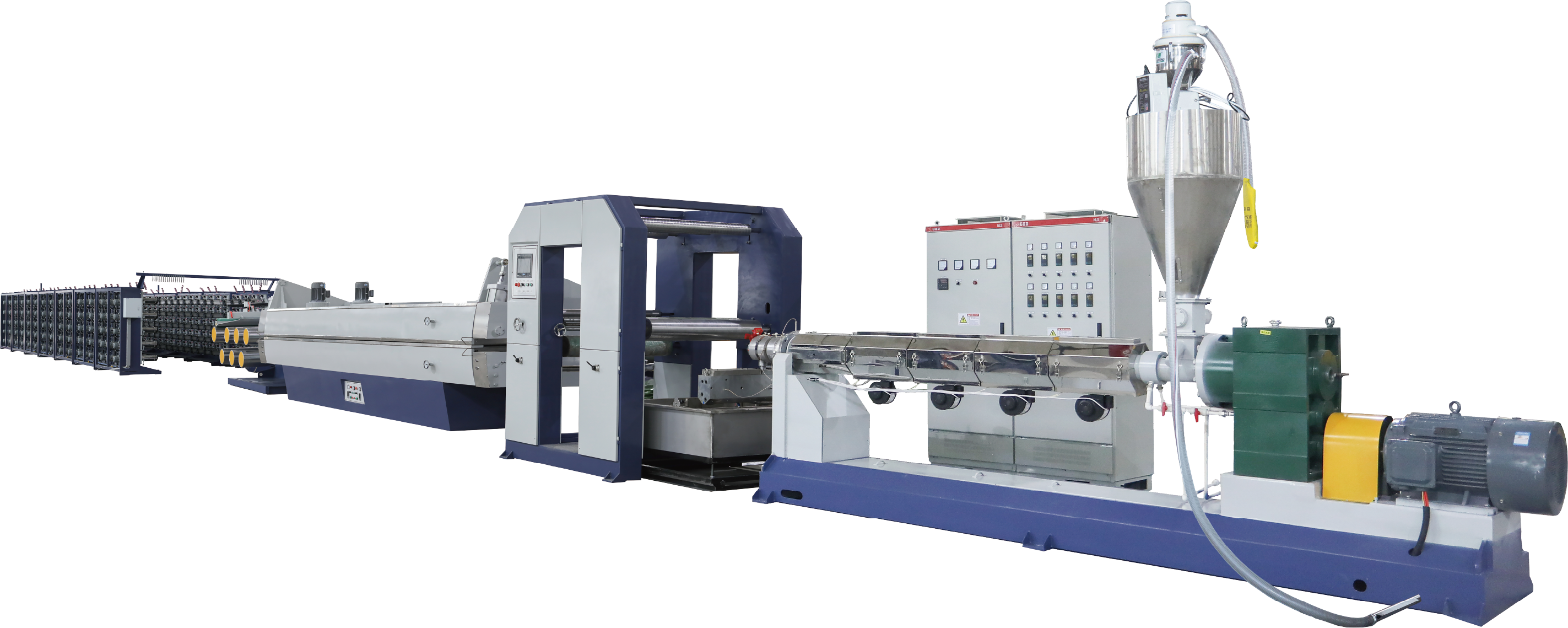
Monofilament Extrusion Machines: Converting Polymer Pellets into Synthetic Grass Fibers
Extrusion Process Mechanics – Melting, Filtration, and Die Shaping
Monofilament extrusion machines take those little polymer pellets, mostly polyethylene or polypropylene, and turn them into long strands of synthetic grass fibers. These machines work by heating up a big metal barrel somewhere between 200 and 280 degrees Celsius. Inside there are these spinning screws that basically melt all the pellets together until they form one smooth substance. Before moving on though, the mixture goes through special filters to catch any impurities that might make the fibers weaker later on. After filtering, the clean molten plastic gets pushed through something called spinneret dies. Think of these as tiny steel plates with super small holes in them. Each hole determines what shape the finished fiber will have when it comes out. Once extruded, the hot plastic needs to cool down fast. Manufacturers use either air or water baths for this part of the process. How quickly it cools makes a big difference too. Things like how hot different parts of the machine are set, how fast those screws spin inside, and exactly how fast the plastic is cooled all affect whether the final product can handle stress without breaking, stretch properly, or maintain consistent size throughout production runs.
Material Selection & Blade Design Control – How Parameters Define Realism and Durability
Polyethylene (PE) continues to be the go-to material for most artificial turf installations because it stands up well to sunlight, feels good underfoot, and typically lasts over 15 years when installed properly. Polypropylene (PP) gets used mainly in areas that take a beating, such as the infill sections of sports fields where the grass blades need to stay upright despite heavy foot traffic. The shape of the blades matters just as much as the material choice. Manufacturers create different profiles through their die designs - think C-shapes, W-profiles, or even diamond shaped cross sections. These designs help replicate how real grass looks and behaves, spread light better across the surface, and fight off that flat, matted appearance over time. Most quality turf uses fibers around 120 to 180 microns thick. This range gives the right mix of strength to keep from getting flattened out, but still allows them to move naturally in response to wind and activity. Today's advanced manufacturing equipment now includes systems that monitor material flow properties in real time and adjust die pressures automatically. This means producers can switch between different fiber types during the same production batch, creating custom blends that meet specific performance needs without slowing down production speeds or affecting product quality.
Tufting Machines: Precision Stitching of Fibers into Backing for Structural Integrity
Tufting machines anchor extruded monofilaments into woven or nonwoven backing materials using high-speed, computer-guided needle systems. This mechanical interlocking forms the structural foundation of synthetic turf—and directly determines its service life, pile stability, and dynamic response to foot traffic and environmental loading.
Needle Configuration, Gauge, and Stitch Density – Impact on Pile Height and Wear Resistance
Three interdependent parameters define tufting performance:
- Needle configuration: Double- or triple-needle setups create staggered stitch patterns that distribute shear forces across multiple rows, significantly improving fiber retention during aggressive use.
- Gauge (center-to-center needle spacing): A narrow 3/8-inch gauge yields up to 16 stitches per inch—ideal for sports-grade turf requiring maximum density and resilience.
- Stitch density: Densities exceeding 200 stitches/m² increase anchoring points by ~40% versus standard landscape grades, markedly reducing pile displacement and matting over time. While higher densities compress nominal pile height during manufacturing, they extend functional lifespan: turf with a ¾-inch pile maintains upright orientation and shock absorption 30% longer when stitch density exceeds 180/m². Application-specific optimization is standard—landscape installations favor lower densities for cost and aesthetic softness; athletic fields prioritize density and gauge for biomechanical safety and durability.
| Parameter | Low Setting Impact | High Setting Impact |
|---|---|---|
| Gauge | Sparse fiber coverage, uneven wear | Uniform distribution, enhanced load dispersion |
| Stitch Density | Reduced abrasion resistance, higher matting risk | Greater anchoring, but less flexibility in pile height adjustment |
| Needle Type | Single-row vulnerability to pull-out | Multi-row configurations improve shear resistance and tuft bind |
Coating and Curing Systems: Bonding Fibers to Backing with Latex or Polyurethane
Coating systems stick those tufted fibers firmly to their backing material, stopping problems like fraying edges, layers coming apart, or early breakdown from things like machine wear or bad weather conditions. Most manufacturers go with either latex or polyurethane as their main binding agents. Latex works well for budget conscious projects since it bends nicely and dries quickly, but doesn't hold up as long in harsh conditions. Polyurethane on the other hand stands up better against sunlight damage and stays attached much longer in tough situations. Proper application matters a lot though. When everything goes right during installation and curing processes, these coatings typically keep around 95% of all fibers intact. But this high retention rate depends heavily on getting the coating spread evenly throughout, making sure it penetrates deeply enough into the fibers, and achieving good chemical bonding between layers.
Coating Application Methods – Knife-Over-Roll vs. Metering Roll – Uniformity and Adhesion Trade-offs
When deciding between knife over roll versus metering roll application methods, what really matters comes down to what kind of performance is needed most. The knife over roll technique works by pressing a sharp blade against a spinning roller which applies thicker adhesive layers ranging from about 0.8 to 1.2 millimeters thick. This creates stronger bonds that are absolutely necessary for sports turf installations since each grass tuft needs at least 12 Newtons of binding force to hold properly. But there's a catch worth mentioning here too. When the adhesive gets too runny or thick during operation, we often see inconsistent coverage happening somewhere around 15% of the time across different jobs. Metering rolls take a completely different approach though. These systems depend on very precise gap adjustments between two rollers spinning in opposite directions. They produce thinner but much more uniform coatings measuring approximately 0.5 to 0.7 mm with only about plus or minus 2% variation in thickness. For ornamental lawns where appearance matters more than sheer durability, this consistency makes all the difference visually even if the mechanical requirements aren't as intense compared to athletic surfaces.
| Parameter | Knife-Over-Roll | Metering Roll |
|---|---|---|
| Adhesion Strength | High (≥90% retention; ≥12 N/tuft) | Moderate (75–85%; ~8–10 N/tuft) |
| Coating Uniformity | Variable (±5–8% thickness) | Consistent (±2% variance) |
| Ideal Use Case | Sports fields, high-traffic commercial turf | Residential landscaping, aesthetic-focused installations |
The curing process varies between materials. Polyurethane needs about 36 to 48 hours in controlled conditions with specific humidity levels and room temperature before it fully cross-links. Latex takes less time, usually under 24 hours to cure, though it breaks down quicker when exposed to sunlight for long periods. When choosing binders and how they're applied, manufacturers look at what the final product will be used for. They check against various standards like the FIFA Quality Programme for footballs or ASTM F355 which deals with impact absorption. These standards help make sure products meet global safety requirements and perform as expected across different applications.
Post-Production Artificial Grass Machines: Cleaning, Brushing, and Quality Assurance
The final processing stage makes sure that synthetic turf looks good and works properly before it gets shipped out. Brushing machines do most of the heavy lifting here. They lift up those tiny fibers, separate them, and arrange everything so the pile looks natural again. This helps prevent flattening when people walk on it or when dirt gets blown around. Cleaning is another important step too. Specialized cleaning equipment uses suction along with gentle vibrations to get rid of leftover polymer dust, cutting fluids, and any loose strands without harming the actual fibers themselves. When it comes to quality checks, there are several high tech tools at work. Laser sensors measure how even the pile height is across the surface, keeping things consistent within about half a millimeter. Optical scanners run over the material at pretty fast speeds looking for problems like uneven colors, bad stitching spots, or issues with coatings. All these finishing touches follow strict quality control procedures set by ISO 9001 standards and meet requirements from both EN 15330-1 and ASTM F1951 specifications. What starts as basic tufted fabric eventually becomes something ready for installation anywhere, guaranteed to perform well, stay safe underfoot, and maintain its attractive appearance over time.
FAQ
What materials are commonly used in artificial grass production?
Polyethylene (PE) and Polypropylene (PP) are the most commonly used materials. PE is favored for its durability and comfort, while PP is used in high-traffic areas.
What is the purpose of extrusion machines in artificial grass manufacturing?
Extrusion machines melt polymer pellets into synthetic grass fibers, giving them shape and strength through a process involving melting, filtering, and cooling.
How is tufting crucial to artificial turf production?
Tufting involves precision stitching of fibers into backing materials, which ensures structural integrity, stability, and lifespan of synthetic turf.
What are the differences between knife-over-roll and metering roll application methods?
Knife-over-roll applies thicker adhesive layers and is suited for high-traffic areas, while metering roll provides thinner, more uniform coatings ideal for aesthetic purposes.
Why is curing necessary in artificial grass production?
Curing solidifies coatings, ensuring fibrous binding and durability. Different materials have different curing times and conditions.
Table of Contents
- Monofilament Extrusion Machines: Converting Polymer Pellets into Synthetic Grass Fibers
- Tufting Machines: Precision Stitching of Fibers into Backing for Structural Integrity
- Coating and Curing Systems: Bonding Fibers to Backing with Latex or Polyurethane
- Post-Production Artificial Grass Machines: Cleaning, Brushing, and Quality Assurance