
 EN
EN


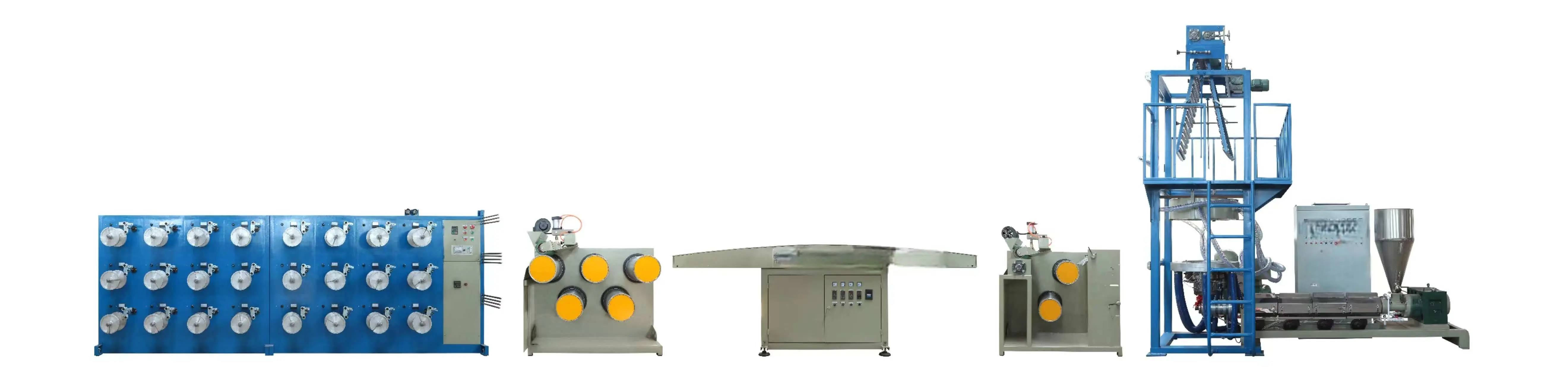
Material Behavior Fundamentals: How LLDPE, LDPE, and HDPE Respond in Blown Film Extrusion
Melt strength, MI, and bubble stability: Why LLDPE excels in stretch film applications
Bubble stability in blown machine stretch film production hinges on melt strength and Melt Index (MI). While LDPE’s long-chain branching delivers high melt strength and a forgiving processing window, LLDPE is the dominant choice for high-performance stretch film due to its superior tensile strength, puncture resistance, and toughness. Its linear molecular structure yields lower inherent melt strength—but this is effectively managed by selecting grades with MI values between 0.5–2.0 g/10 min. Lower MI increases chain entanglement, enhancing bubble stability without sacrificing processability. Optimized LLDPE formulations have been shown to reduce film gauge variation by up to 15% compared to unmodified LDPE in comparable applications, directly improving yield and mechanical consistency.
Crystallinity and freeze-line dynamics: Implications for gauge control and optical clarity
Crystallinity governs freeze-line behavior—and thus gauge uniformity and optical performance. HDPE’s high crystallinity (up to 80%) drives rapid solidification and a sharp, fixed freeze line, which can lock in orientation-induced thickness variations. LDPE’s branched architecture slows crystallization, producing a diffuse freeze line that promotes better gauge uniformity and higher clarity. For blown machine stretch film, LLDPE strikes a strategic middle ground: its moderate crystallinity allows operators to raise the frost line—giving polymer chains time to relax before solidification—thereby reducing haze by over 20% when combined with optimized cooling. This balance supports both load visibility and mechanical integrity without requiring additives or post-processing.
Critical Process Parameters for High-Performance Blown Machine Stretch Film
Die temperature optimization (190–230°C) to balance melt homogeneity and output stability
Precise die temperature control is foundational to consistent gauge and output stability. The 190–230°C range ensures homogeneous melt flow while minimizing viscosity gradients that cause thickness fluctuations. For LLDPE, operating near the upper end of this range enhances melt strength and supports stable bubble formation. LDPE performs best at slightly lower temperatures to avoid thermal degradation, while HDPE requires tighter control to prevent premature crystallization at the die lip. Uniform zone-to-zone temperature profiling across the die prevents melt fracture, reduces gel formation, and improves line speed—without increasing downstream cooling demand. This level of thermal precision directly mitigates bubble instability, a primary source of gauge variation and mechanical inconsistency.
Blow-up ratio (BUR) and frost line height tuning for tensile strength and film uniformity
BUR and frost line height are the two most influential levers for controlling molecular orientation and final film performance. A BUR of 2:1 to 3:1 enhances transverse-direction tensile strength—critical for load containment—while raising the frost line allows greater relaxation in the machine direction, improving orientation balance and reducing internal stress. However, excessive frost line elevation risks sag and gauge bands. Engineers tune these parameters in tandem: LLDPE tolerates higher BUR and more flexible frost line positioning due to its superior bubble stability; HDPE demands tighter BUR control (typically ≤2.5:1) and a fixed, low frost line to prevent wrinkling. Real-time monitoring ensures the resulting film delivers consistent elongation, puncture resistance, and cling—key metrics for reliable high-speed wrapping.
Cooling Strategy and Frost Line Management Across Polyolefin Types
LDPE’s cooling sensitivity vs. HDPE’s rapid crystallization: Mitigating gauge variation
LDPE’s broad molecular weight distribution creates a wide softening range, leaving the bubble deformable well above the frost line. This cooling sensitivity necessitates gradual, circumferentially uniform cooling—often achieved by reducing air ring velocity and elevating the frost line by 10–15% to stabilize the bubble before solidification. In contrast, HDPE’s rapid crystallization below ~130°C locks in any non-uniformity present at the die exit. To counteract this, operators enforce strict die gap tolerance (±2%) and maintain a sharp, stable frost line at 200–300 mm above the die. Dual-lip air rings ensure consistent radial cooling, suppressing gauge variation to under 3%. These differentiated strategies reflect each resin’s inherent thermal response—and are essential for maintaining stretch film performance across polyolefin types.
Performance Trade-Offs and End-Use Optimization for Stretch Film Applications
Tear resistance, puncture strength, and stiffness: Aligning resin choice with load containment needs
Load containment requires balancing stiffness, tear resistance, and energy absorption. HDPE delivers high secant modulus (>800 MPa), minimizing sag under sustained load—but its brittleness limits impact resistance: typical dart drop values fall below 100 g, and Elmendorf tear strength is often <300 g. LLDPE offers markedly superior puncture resistance—slow puncture energy commonly exceeds 15 J/mm—thanks to its narrow molecular weight distribution and controlled comonomer incorporation, which promote ductile deformation and energy dissipation. For demanding applications involving heavy or irregularly shaped loads, multilayer structures (e.g., HDPE or LDPE core with LLDPE skins) combine stiffness and toughness more effectively than monolayer films—optimizing both load integrity and damage resistance without compromising processability.
Clarity, sealability, and cling: Why LLDPE dominates high-performance blown machine stretch film
LLDPE is the preferred resin for high-performance blown machine stretch film due to its unique combination of optical clarity, heat sealability, and natural cling. Hexene- or octene-based LLDPE grades achieve haze levels below 2%, enabling barcode scanning and visual inspection—unlike LDPE, which typically exhibits >5% haze. Its lower crystallinity also delivers rapid hot-tack development and low seal initiation temperatures, essential for seamless integration into automated high-speed packaging lines. Crucially, LLDPE generates inherent cling (50–100 g/cm) without tackifier additives, thanks to controlled surface energy and frictional asymmetry—low COF on the outer layer ensures inter-layer adhesion without blocking. These synergistic properties allow thinner, stronger films that reduce material usage while maintaining load stability across global logistics environments.
FAQ
What is the importance of Melt Index (MI) values in blown film extrusion?
Melt Index (MI) values play a crucial role in determining the melt strength and bubble stability during blown film extrusion. Lower MI values enhance chain entanglement, improving stability without compromising processability. This is especially important for LLDPE formulations, which rely on optimized MI ranges for superior performance.
How does crystallinity influence the freeze-line dynamics of different polymers?
Crystallinity affects the freeze-line behavior and gauge uniformity. Polymers like HDPE with high crystallinity solidify rapidly, while LDPE’s branched architecture slows down crystallization, resulting in better control and optical clarity. LLDPE offers a balance, supporting both load visibility and mechanical stability.
Why is die temperature control critical in stretch film production?
Die temperature control ensures homogeneous melt flow and minimizes thickness fluctuations. Different polymers require specific temperature ranges to prevent thermal degradation or premature crystallization, thus improving bubble stability and mechanical consistency.
What are the benefits of using multilayer structures in stretch film applications?
Multilayer structures combine different polymer types to optimize performance. For instance, HDPE or LDPE cores provide stiffness, while LLDPE skins enhance toughness and puncture resistance, making the structure ideal for heavy or irregular loads.
Why is LLDPE preferred for high-performance stretch films?
LLDPE is favored for its superior optical clarity, heat sealability, and inherent cling properties. It allows for thinner films, reduces material usage, and maintains load stability without requiring additives, making it ideal for global logistics environments.
Table of Contents
- Material Behavior Fundamentals: How LLDPE, LDPE, and HDPE Respond in Blown Film Extrusion
- Critical Process Parameters for High-Performance Blown Machine Stretch Film
- Cooling Strategy and Frost Line Management Across Polyolefin Types
- Performance Trade-Offs and End-Use Optimization for Stretch Film Applications
-
FAQ
- What is the importance of Melt Index (MI) values in blown film extrusion?
- How does crystallinity influence the freeze-line dynamics of different polymers?
- Why is die temperature control critical in stretch film production?
- What are the benefits of using multilayer structures in stretch film applications?
- Why is LLDPE preferred for high-performance stretch films?