
 EN
EN



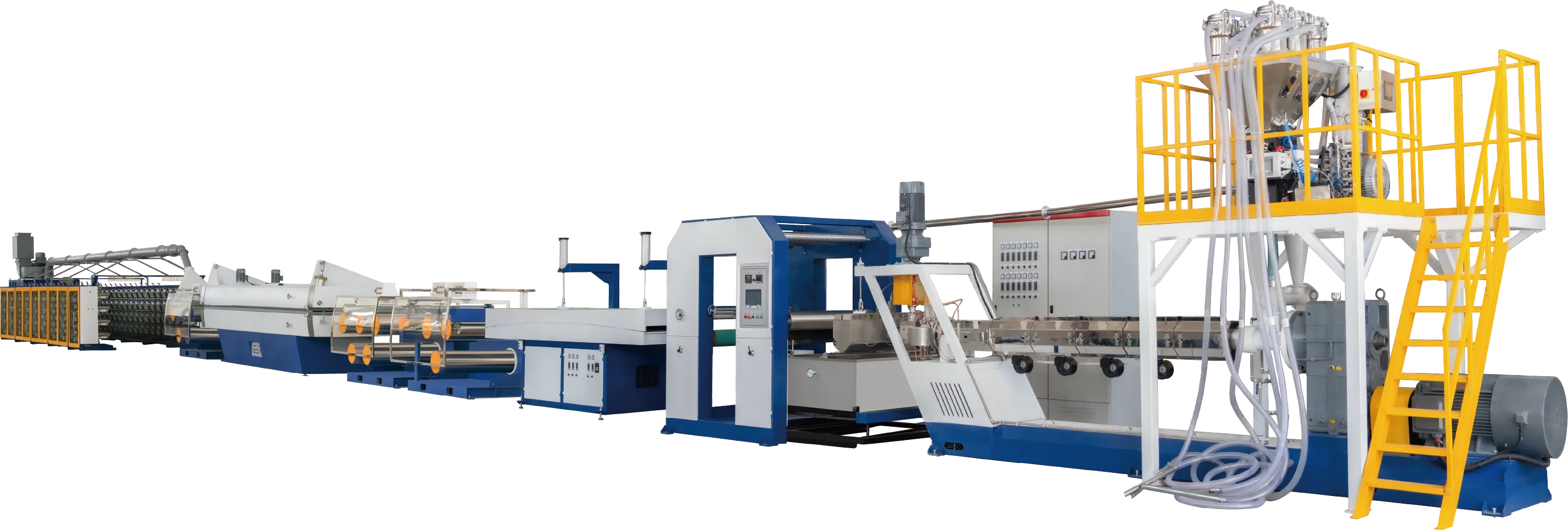
Core Temperature Zones in the Plastic Flat Film Drawing Machine
Precise thermal management governs every phase of film formation in a plastic flat film drawing machine. Unlike simpler extrusion processes, film drawing demands synchronized temperature control across three critical zones—each defined by distinct physics and material response windows.
Die Lip Zone: Controlling Melt Flow and Initial Film Formation
The polymer melt comes out of the die and starts forming what we call the film web at this stage. If temperatures vary more than 1 degree Celsius up or down, it messes with how molecules line up, which can lead to those annoying gauge bands or even worse problems like sharkskin on the surface. Keeping things evenly heated along the entire width of the die lip is really important because it maintains the right consistency in the melt. This helps keep everything stable when we start stretching the material. We need to make sure the melt stays about 5 degrees warmer than the point where the polymer would normally start to solidify otherwise we run into all sorts of production headaches later on.
Air Gap Region: Managing Solidification Kinetics and Web Stability
The area right after the die exit and before reaching the chill roll is where things get interesting for the film material. It cools down fast here while stretching in one direction. Just a small temperature difference of about 2 degrees between the edges and middle can cause problems like curling at the edges, instability when it narrows during processing, and variations in tension over 8%. That's why many manufacturers rely on infrared systems these days. These setups adjust cooling as needed to keep temperatures within half a degree across the whole width of the material. Maintaining such tight control isn't just nice to have it's actually essential for getting consistent results without internal stresses messing up the final product quality.
Chill Roll & Take-Up Zone: Final Crystallinity Lock-In and Dimensional Stability
When materials come into contact with a temperature controlled chill roll, it stops the molecules from moving around and fixes their final crystal structure. Getting the chill roll temperature right within about plus or minus 1.5 degrees Celsius matters a lot because otherwise we get uneven shrinking problems. Take PET film as an example it can shrink across the width by about 0.8% for every degree off target according to standard ISO 1183-2. Keeping temperatures so accurate helps avoid things like warping and cloudiness in the material. The result is something that stays dimensionally stable within 0.1% variation at most which becomes really important when making high barrier packaging films needed for processes like thermoforming or laminating different layers together.
How Thermal Variability Impacts Critical Film Quality Metrics
Crystallinity Gradients and Their Direct Effect on Surface Resistivity (±0.8% per 2°C ΔT)
Thermal variability directly governs polymer crystallization kinetics. Deviations exceeding ±2°C induce measurable crystallinity gradients across the web, altering charge dissipation pathways and shifting surface resistivity by ±0.8% per 2°C change—verified in peer-reviewed polymer dielectric studies. For capacitor films and EMI shielding applications, such variation compromises:
- Barrier performance, due to inconsistent lamellae density
- Electrical reliability, through localized conductive/resistive zones
- Downstream process stability, especially during metallization or coating
Thermal History-Induced Optical Defects: Haze, Gloss Inconsistency, and Clarity Loss
Non-uniform cooling trajectories lock in molecular stress patterns that cause irreversible optical defects. Rapid solidification below optimal temperatures traps amorphous regions, scattering light at micron-scale interfaces. This elevates haze by over 15 NTU and reduces gloss uniformity by >30 GU (ASTM D2457). Key failure modes include:
- Surface micro-waviness, driven by differential shrinkage rates
- Internal stress whitening, occurring when crystallinity drops below 40%
-
Refractive index mismatches, between machine-direction and cross-direction chains
Consistent chill-roll contact and optimized air-knife profiles stabilize solidification fronts and suppress these defects.
Advanced Temperature Control Strategies for High-Speed Plastic Flat Film Drawing Machines
Operating at speeds exceeding 120 m/min demands unprecedented thermal precision. Temperature fluctuations as small as 2°C can shift surface resistivity by ±0.8%, making real-time control essential for high-volume production.
Observer-Based Real-Time Thermal Uniformity Control Across Web Width
Infrared thermography and embedded micro-sensors feed data to multi-variable controllers that dynamically adjust localized heating and cooling zones. Predictive algorithms model thermal propagation to compensate for tension-induced variations. This PID-based approach maintains spatial uniformity within ±0.5°C—preventing crystallinity gradients that drive haze and clarity loss while preserving optical integrity.
Balancing Line Speed (≥120 m/min) with Thermal Homogeneity Tolerance
Higher throughput amplifies cooling asymmetry, especially at film edges. The key trade-off involves optimizing three interdependent parameters:
| Control Lever | Slow-Speed (<80 m/min) | High-Speed (≥120 m/min) | Impact Tolerance |
|---|---|---|---|
| Chill Roll ΔT | ±1.2°C | ±0.4°C | Haze +12% / 1°C |
| Air Gap Residence | 0.8–1.2 sec | 0.3–0.5 sec | Gloss –8% / 0.2 s |
| Heater Response | 120 ms | <45 ms | Thickness ±3 µm |
Modern systems automate segmented chill roll control and air-knife modulation, enabling 20% throughput gains while holding thermal drift beneath the ±0.8% resistivity threshold—preserving polymer integrity and dimensional fidelity.
FAQ on Plastic Flat Film Drawing Machines
What is the main purpose of temperature control in plastic flat film drawing machines?
The main purpose of temperature control in plastic flat film drawing machines is to manage film formation, ensuring consistent material properties, dimensional stability, and high-quality output.
Why is precise temperature management crucial in the die lip zone?
Precise temperature management in the die lip zone is crucial to avoid gauge bands and surface defects such as sharkskin from polymer misalignment and to maintain melt consistency during stretching.
How does thermal variability affect film quality?
Thermal variability affects film quality by causing crystallinity gradients, altering surface resistivity, and compromising barrier performance, electrical reliability, and process stability.
What are common optical defects caused by non-uniform cooling?
Common optical defects include haze increase, gloss inconsistency, and clarity loss, often driven by molecular stress patterns and differential shrinkage rates.
How do modern systems improve throughput and maintain thermal control?
Modern systems improve throughput and maintain thermal control through automated chill roll control and air-knife modulation, balancing speeds with homogeneity to optimize production rates.
Table of Contents
- Core Temperature Zones in the Plastic Flat Film Drawing Machine
- How Thermal Variability Impacts Critical Film Quality Metrics
- Advanced Temperature Control Strategies for High-Speed Plastic Flat Film Drawing Machines
-
FAQ on Plastic Flat Film Drawing Machines
- What is the main purpose of temperature control in plastic flat film drawing machines?
- Why is precise temperature management crucial in the die lip zone?
- How does thermal variability affect film quality?
- What are common optical defects caused by non-uniform cooling?
- How do modern systems improve throughput and maintain thermal control?