
 EN
EN



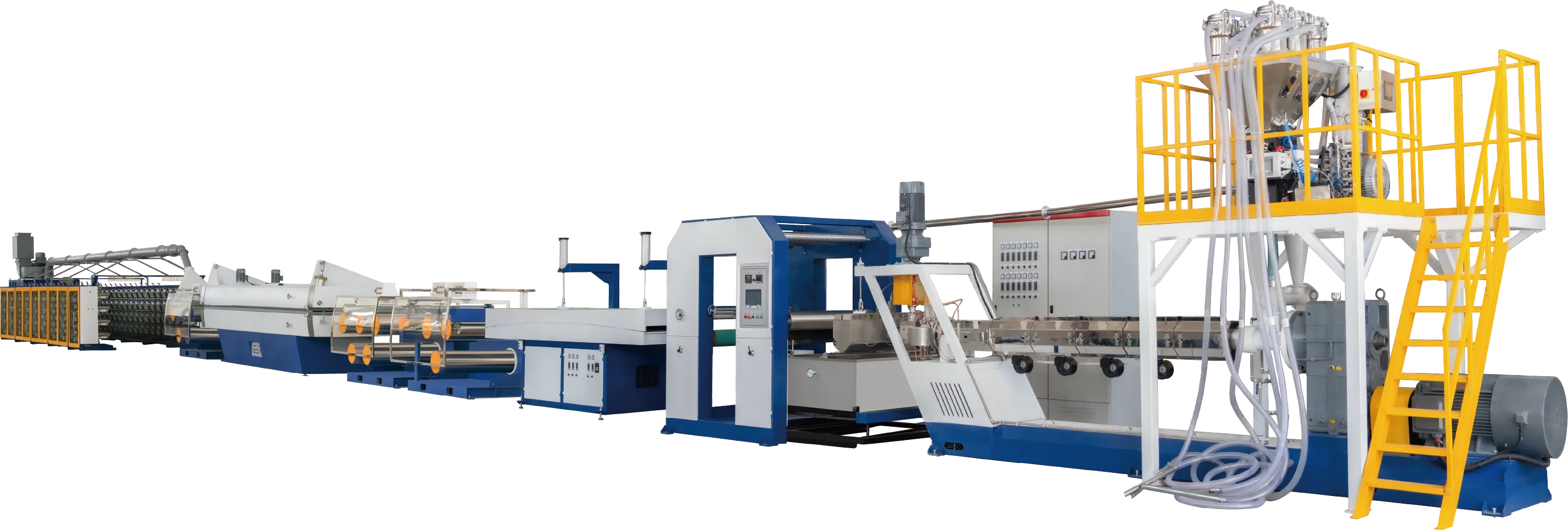
Core Engineering Principles of the Plastic Flat Film Drawing Machine
How Extrusion and Orientation Physics Enable Precision Film Thinning
Film formation starts during extrusion when polymer granules get melted down and pushed through a specially designed die opening. Once formed, this flowing curtain of molten material goes into an area where controlled stretching takes place. The stretching creates alignment in the polymer chains which makes the film stronger but thinner at the same time. When working between the glass transition point and actual melting temperature of the polymer, elastic deformation allows for stretching along one direction without breaking apart. Keeping melt viscosity steady requires careful temperature control throughout the whole process area, usually maintaining differences no greater than about 1.5 degrees Celsius. Most operations run with draw ratios somewhere between 5 to 8 times, resulting in films that have pretty consistent thickness. Production typically moves at around 15 to 25 meters per minute. These conditions lead to better barrier properties through stress induced crystallization improvements of approximately 40%, all while still keeping good optical clarity. This characteristic gives it an edge over traditional cast film techniques in many applications.
Critical Components: Preheating Rolls, Stretch Zones, and Edge-Guiding Systems
Three synchronized subsystems deliver micron-level dimensional control:
- Infrared preheating rolls, PID-controlled for emissivity, maintain film temperature between 120–160°C (polymer-dependent) to ensure uniform molecular mobility ahead of stretching
- Multi-stage stretch zones use servo-driven differential rollers to apply calibrated tension gradients—achieving draw consistency within 98% across the web width
- Laser-guided edge pinning systems, equipped with CCD sensors, detect lateral deviations as small as 0.2 mm and trigger real-time micro-adjustments to tenter chains, preventing edge curling
This integration ensures homogeneous stress distribution. Without it, industrial benchmarks show thickness variation exceeding 3%. Collectively, these systems reduce neck-in deformation by 60% versus conventional designs and sustain tensile strength uniformity above 95% across the full film web.
Precision Manufacturing Process for the Plastic Flat Film Drawing Machine
CNC-Machined Frame Fabrication and Thermal Stress Calibration
Structural integrity starts with those CNC machined frames that stick to around 0.01 mm in dimensional tolerance. This kind of precision matters a lot when it comes to aligning components properly and keeping film uniform across the board. After machining is done, these frames go through what we call thermal stress calibration. Basically, they get heated and cooled repeatedly between minus 20 degrees Celsius all the way up to 80 degrees. This process mimics real world conditions so any internal stresses that might lead to warping can be worked out beforehand. Frames that have gone through this calibration stay rigid even when loaded continuously, which cuts down on film thickness variations by about 18 percent compared to regular frames. That makes a big difference for machines running at high speeds where vibrations just aren't acceptable.
Precision Roll Grinding and Surface Hardness Validation (HV950+)
Contact rolls get ground into perfect cylinders with surface finishes under 0.2 microns Ra, and their diameters stay consistent within plus or minus 5 microns. This attention to detail stops problems like slippage and uneven tension when running materials through them. After grinding, we subject these rolls to vacuum heat treatment that pushes their hardness past HV950 levels, which is actually about 40 percent harder than what most industry standards require. To make sure everything checks out, we run micro indentation tests at twelve different spots on each roll's surface. These tests confirm that the hardness remains uniform across the whole thing, so it can stand up against those tough polymer compounds that tend to wear down regular equipment. When we combine this kind of geometric accuracy with such extreme surface hardness, the result is rolls that last roughly three times longer than standard ones. Plus, they maintain film thickness tolerances within 0.3 microns even when operating at high speeds for extended periods.
Rigorous Quality Assurance: Validating Performance Before Shipment
Film Uniformity Mapping via In-Line Laser Thickness Sensors (±0.3 µm accuracy)
Getting consistent film thickness right really matters for both performance and overall yield rates. The machines come equipped with built-in laser sensors that map out the whole web's thickness in real time at around 0.3 micrometers resolution. To put that into perspective, it's roughly 1/100th the size of a single strand of human hair. Traditional spot checks just don't cut it anymore when we're talking about such fine tolerances. With our system constantly monitoring throughout setup, operators get instant feedback so they can make adjustments on the fly before issues even become problems. Before shipping any unit, we run comprehensive thickness tests across the complete web width. These tests confirm whether the machine actually hits those tight ±1.5% tolerance requirements specified in the design specs. This means production lines can start running confidently knowing they've got reliable, repeatable results from day one without having to waste time troubleshooting later on.
Proven Impact on Your Production: Real-World Yield Improvements
Case Study: 22% Reduction in Film Breaks After Switching to Our Plastic Flat Film Drawing Machine
One major packaging company saw a 22% drop in film breaks when they installed our plastic flat film drawing machine, putting an end to those frustrating production halts that used to happen all the time. The improvement came mainly because of better tension control and much improved edge guidance systems that kept the film from cracking while running at top speeds. With fewer interruptions, their downtime went down significantly. Annual output jumped by around 17%, and they saved about 28 tons of wasted material each year, which amounts to roughly $340k according to last year's Packaging Efficiency Report. Operators were able to work faster too, with productivity gains hitting 31%. Maintenance bills also took a hit, falling nearly 20% overall. All these numbers point to something pretty straightforward: when manufacturers invest in precise engineering for their film drawing processes, they get real world benefits across multiple areas including product quality, operating expenses, and system reliability.
FAQ Section
What is the primary function of a plastic flat film drawing machine?
The primary function of a plastic flat film drawing machine is to produce thin, strong, and uniform plastic films through extrusion and controlled stretching of polymer materials.
How does the machine reduce film thickness variation?
The machine uses CNC-machined frames and thermal stress calibration to ensure structural integrity, while precise roll grinding and surface hardness validation maintain dimensional accuracy. This combination drastically reduces film thickness variation.
Why is laser thickness mapping important in film production?
Laser thickness mapping is vital for achieving consistent film thickness, which directly affects performance and yield rates. It provides real-time feedback that helps operators make instant adjustments, ensuring high precision and reliability in film production.